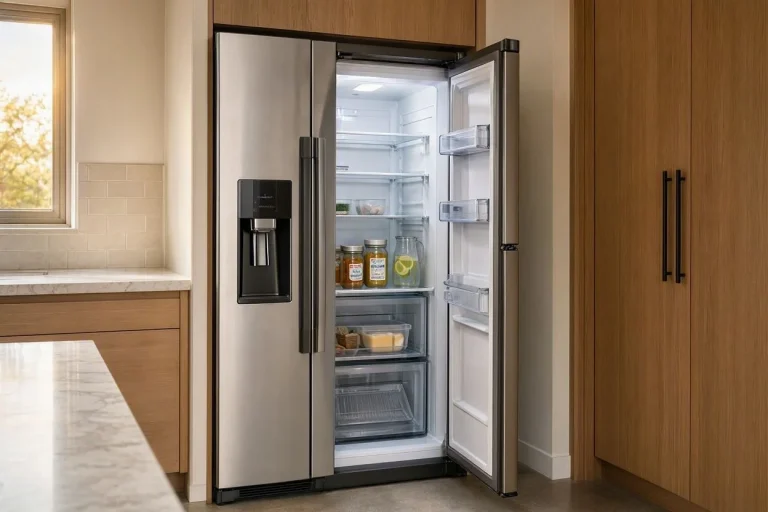
The overflow refrigerator earns its keep eleven months of the year. Then a cold week settles over Bergen County, the garage sits in the high thirties for days, and somebody opens the freezer to find soft ice cream and cubes welded into one lump. Nothing snapped. The machine simply stopped being asked to run.
The thermostat is in the wrong compartment for a cold room
Most ordinary top-freezer and side-by-side refrigerators cool both compartments from a single evaporator, and the control watches one sensor sitting in the fresh-food section. The freezer gets cold as a by-product of the compressor running for the benefit of the refrigerator side. Put that cabinet in a garage at thirty-eight degrees and the fresh-food section is already at its setting with no help at all, so the compressor never receives the call. The freezer, which needs to hold near zero, drifts up toward whatever the garage is doing. That is the whole reason the milk is fine and the ice cream is not.
Read the rating plate before you spend anything
Every manufacturer publishes an ambient range for the room the appliance stands in, and a standard refrigerator generally wants somewhere between roughly fifty-five and one hundred ten degrees. Below the low end, behavior stops being predictable: run times collapse, and on a long cold night refrigerant migrates and compressor oil thickens, so the restart is harder on the machine than the running ever was. Cabinets sold as garage-ready get around this with a second sensor or a small heater near the control. The plate normally sits inside, on the side wall next to the crisper drawer. Take a picture of the entire label, serial number and all.
What actually helps
- Keep the freezer full. Mass holds temperature through the long gaps between compressor runs. Jugs of water cost nothing and work.
- Move it if you have anywhere to move it to. A basement that stays above fifty-five all winter is a far better home for a second unit than an attached garage, and the relocation is free.
- Insulate the room, not the appliance. An insulated garage door and weatherstripping at the bottom help. Wrapping the cabinet or blocking the toe-kick grille does not, because heat still has to leave the condenser.
- Ask whether your model has a garage kit. Several manufacturers sell a small heater assembly for the control area on the models that accept one. It is an inexpensive part when it exists.
- Get it off the extension cord. A compressor starting through a long undersized cord pulls hard on the start relay, and the relay is what pays for that arrangement. Its own grounded outlet, nothing else on it.
The summer version of the same argument
August flips the problem over. A closed garage climbing past ninety-five, with condenser coils wearing a felt of dust, lawn clippings and dryer lint, gives a compressor no way to shed heat, so it runs and runs and still cannot reach the setting. Twice a year with a coil brush and a vacuum is maintenance rather than housekeeping for a unit living out there. Nor’easters add their own contribution: power leaves and comes back hard, and control boards in refrigerators are what usually pays that bill.
Four things to check before you call
- Put an independent thermometer in each compartment overnight and write down both readings.
- Note the temperature of the garage or basement at the same time. Those three numbers together answer most of this on the phone.
- Stand there a few minutes and listen. A cabinet that is silent for hours in a cold room is behaving exactly as designed. One that runs continuously and never arrives is a different conversation entirely.
- Test the door seal. Close a dollar bill in the door and pull it out. If it slides free with no drag, the gasket has given up, and a garage unit that spends August in humidity loses gaskets faster than one in a kitchen.
When it is worth a technician
If ambient temperature explains what you are seeing, the correct repair is a relocation and it costs you nothing. If the cabinet cannot hold temperature in a heated room, the usual candidates are a start relay, a thermistor that has drifted, a defrost heater or a condenser fan motor, and those are modest parts on a machine that has already paid for itself. Sealed-system work sits in another bracket entirely, and the EPA Section 608 credential exists for exactly that job. Where the money stops making sense on a spare refrigerator, you will be told so instead of quoted for it.
Call (201) 000-0000 with the model number and those temperature readings. Paramus and Teaneck are the only two towns we cover, which keeps the drive short and the schedule tight.