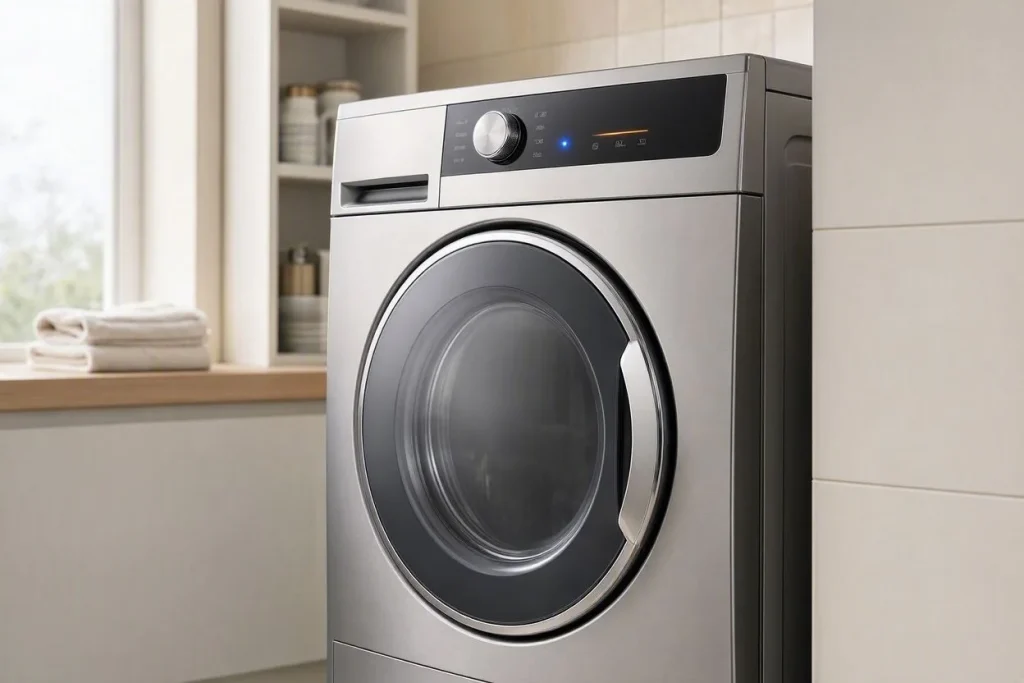
Two cycles to dry one load means start at the wall, not at the machine. In the 1950s split-levels and ranches off Century Road and Forest Avenue, the dryer lives in a lower level or a basement corner, and its exhaust has a long way to travel before it reaches outside air. That duct is part of the appliance whether or not the manual says so, and it is where most of these calls end.
Count the run before you blame the dryer
There is a published limit, and plenty of basement installations quietly exceed it. Residential code allows thirty-five feet of four-inch rigid duct, then subtracts five feet for every ninety-degree elbow and two and a half feet for every forty-five. A run that leaves the machine, turns to clear a joist, travels along a beam, turns again and rises to a cap at the rim joist can spend that whole allowance while the tape measure still reads twenty feet. Count bends, not just distance.
What restriction does inside the cabinet
Heat is the easy half of drying. Carrying humid air out of the house is the half that fails. When exhaust cannot leave at the rate the blower pushes it, drum temperature climbs, the high-limit thermostat opens to protect the machine, and the cycle either quits early or heats in fits. Owners read that as a heating problem and buy an element that was working fine. A second bill hides behind the first: months of running hot takes years off that element and the thermal fuse beside it.
Six checks worth an hour this weekend
- Walk the machine out and look at the flex line. Accordion foil or plastic crushed between the dryer and the wall is the most common restriction in this housing stock. Rigid metal, or short semi-rigid aluminum, is what belongs there.
- Check how the joints are held. Foil tape, never screws. A screw point sticking into the airstream collects lint and starts the blockage that everything else gets blamed for.
- Watch the exterior cap while a cycle runs. Louvers should stand open on the moving air. Painted shut, matted over, or occupied by a nest amounts to a closed pipe, and the caps tucked under a deck or behind a shrub are the ones nobody has looked at in years.
- Feel the discharge. A healthy dryer throws a warm stream you notice from a couple of feet away. A weak, barely warm trickle is an airflow answer whatever the control panel shows.
- Try one short load with the duct off the back, venting into the room with a window open. If it dries the way it used to, you have your answer and can stop reading.
- Wipe the moisture sensor bars. Two metal strips just inside the drum opening tell the control when the laundry is dry. Fabric softener leaves a film across them, they report dry clothes that are still wet, and the cycle shuts down early. Rubbing alcohol on a cloth, thirty seconds, no parts, and it resolves a real share of the calls that come in as stops-too-soon.
Have the duct cleaned properly, not blown at
A long basement run wants a rotating brush on a flexible rod driven the full length, worked from both ends where that is possible. A shop vacuum held at the wall clears the first two feet and leaves every elbow packed. Ask whoever you hire how much of the run they mean to reach, and expect that a joint above a dropped ceiling may have to come apart. Lint piles up there precisely because nothing ever touches it.
Stop and call immediately if
you smell burning or scorched fabric while the machine runs. Lint resting against a hot element is the likeliest source, and it does not wait for the weekend. Cut power at the breaker, close the shutoff on a gas machine, leave the load where it is, and pick up the phone.
What to tell us when you book
Gas or electric. Roughly how far the exhaust travels and how many turns it makes. When the duct was last cleaned, honestly. And which of these two things is happening: the cycle ends early with wet laundry, or it runs its full length and still leaves the load damp. Those point in different directions, and the answer decides which parts ride on the van.
Paramus and Teaneck are the whole territory here, four miles apart on Route 4, so nobody is fighting a highway to reach your basement. The people we send carry insurance and a background check behind them, and they train with the manufacturers whose equipment fills these laundry rooms.
Call (201) 000-0000. If the exhaust route turns out to be the answer, you will hear it plainly, along with what putting it right involves.